
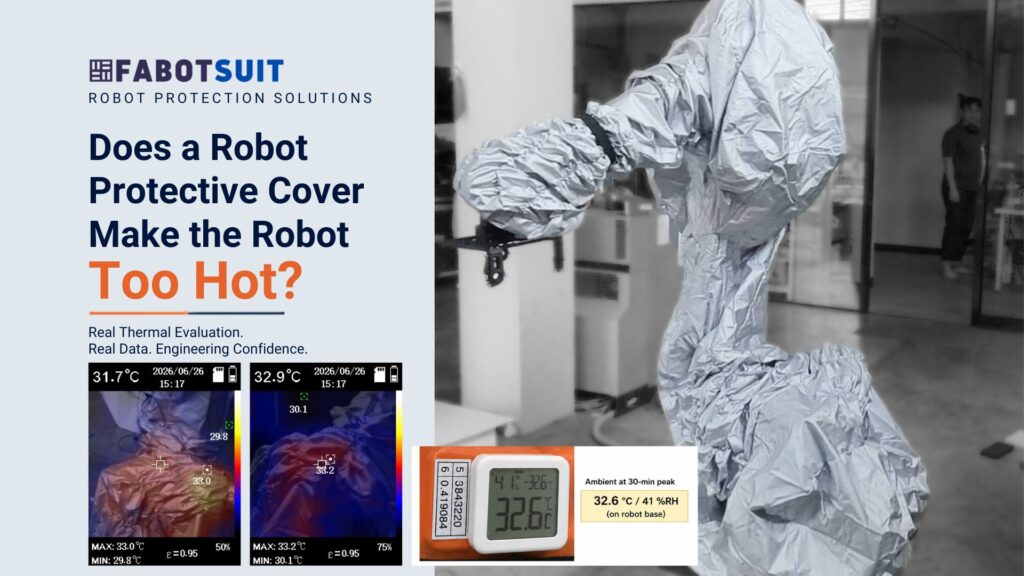
Does a Robot Protective Cover Make the Robot Too Hot?
The Question
One of the most common questions we receive is:
Will installing a robot protective cover cause the robot to overheat?
The answer cannot be based simply on the outer surface temperature of the robot.
Industrial robot manufacturers such as ABB define allowable operating ambient temperature, not maximum external surface temperature.
Therefore, our evaluation focused on the ambient temperature surrounding the robot inside the protective cover, comparing it with ABB’s published operating specifications.
What Does ABB Specify?
According to the ABB Product Specification,
Operating Ambient Temperature
+5°C to +45°C
This means the robot is designed to operate safely provided that the surrounding air temperature remains within this range.
Test Method
We measured
- Factory Ambient Temperature
- Ambient Temperature inside the FABOTSUIT®
- Robot operating continuously
- Same robot program
- Same payload
- Same operating speed
The objective was to determine whether the protective cover significantly increases the operating ambient beyond ABB’s specified limit.
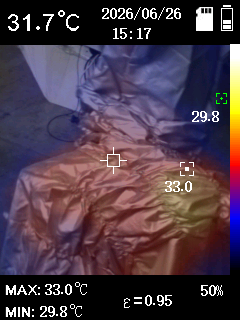
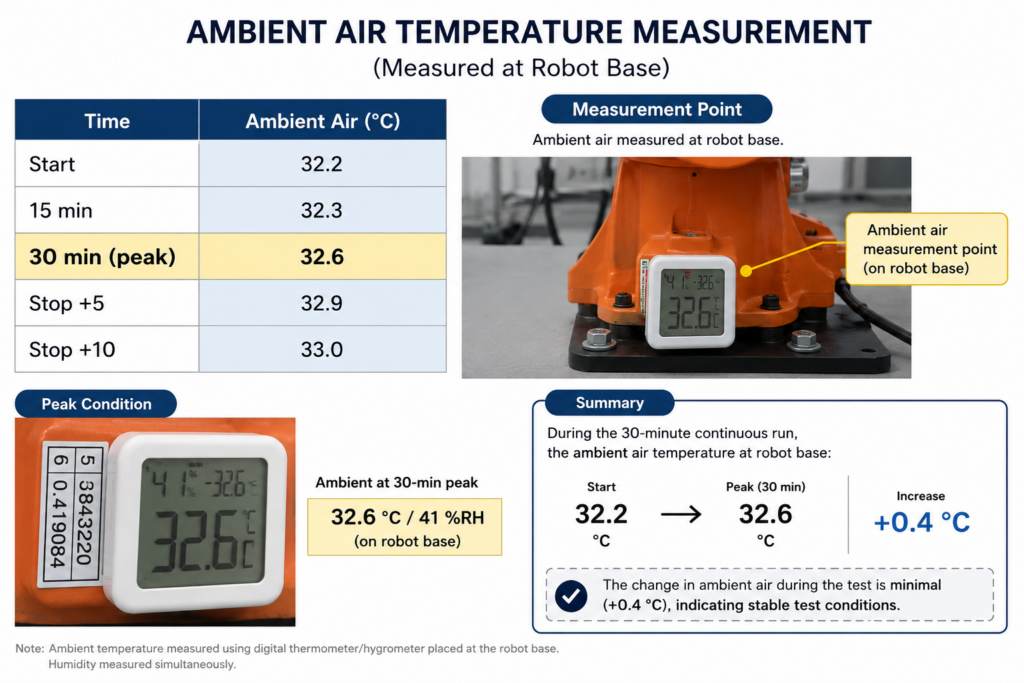
Measured Ambient Temperature
| Condition | Ambient Temperature |
|---|---|
| Without Cover | 31.9°C |
| With FABOTSUIT® | 33.0°C |
| Difference | +1.1°C |
The protective cover increased the surrounding ambient by only approximately 1°C, while remaining approximately 12°C below ABB’s maximum allowable operating ambient of 45°C.
Simple Engineering Calculation
ABB Operating Ambient Limit
45°CMeasured Ambient Inside FABOTSUIT®
33°CRemaining Safety Margin
45 − 33 = 12°CTherefore,
Remaining Operating Margin = 12°C
Even after installing the FABOTSUIT®, the robot still operated well within ABB’s recommended ambient temperature range.
Why Ambient Temperature Matters More Than Surface Temperature
The outer surface of a robot naturally becomes warmer than the surrounding air during operation.
However, robot manufacturers generally do not specify an allowable external surface temperature.
Instead, they define:
- Operating ambient temperature
- Built-in thermal protection
- Overheating supervision
These are the engineering criteria used to determine whether the robot is operating safely.
Additional Verification
During the thermal evaluation,
- Ambient temperature remained within ABB specifications.
- No overheating alarms occurred.
- No thermal protection was triggered.
- Robot operation remained stable throughout the test.
This indicates that the FABOTSUIT® protective cover did not create an abnormal operating environment under the evaluated conditions.
Final Engineering Conclusion
Although any protective enclosure can slightly increase the surrounding temperature, the measured ambient increase with FABOTSUIT® was only approximately 1°C.
The robot continued operating approximately 12°C below ABB’s published operating ambient limit, with no thermal alarms or abnormal behavior observed during testing.
This demonstrates that the FABOTSUIT® protection solution provides effective environmental protection while maintaining operating conditions within the manufacturer’s recommended range under the tested conditions.
