
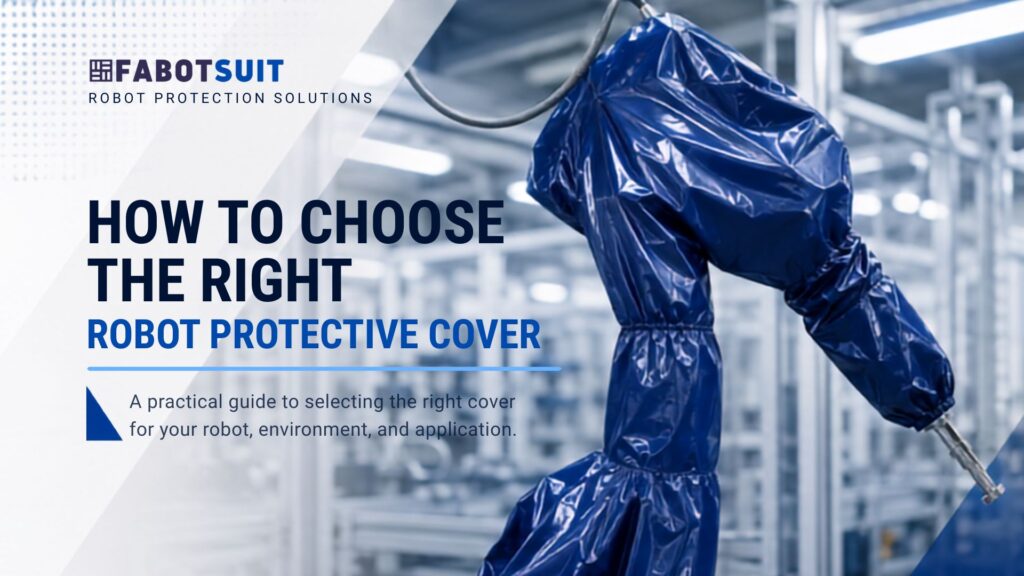
How to Choose the Right Robot Protective Cover | FABOTSUIT®
Not all industrial robots operate under the same conditions—and not all robot protective covers are designed to solve the same challenges.
Whether your robot is exposed to welding spatter, coolant, paint overspray, abrasive dust, chemicals, or high temperatures, selecting the right protection solution is essential for maintaining reliable production and reducing maintenance.
The best robot protective cover is not simply the one made from a particular fabric. It is the one engineered around your robot, your application, and your operating environment.
1. Start with Your Operating Environment
The first question shouldn’t be:
“Which fabric should I choose?”
Instead, ask:
“What is my robot exposed to?”
Common environmental hazards include:
- Dust and fine particles
- Water and water mist
- Oil and coolant
- Chemicals
- Paint overspray
- Welding spatter
- Radiant heat
- Metal chips
- Abrasive particles
- Cleanroom environments
- Food processing applications
Each environment requires a different protection strategy.
2. Understand Your Robot’s Motion
Every industrial robot has unique:
- Motion range
- Joint configuration
- Reach
- Axis movement
- Operating speed
- Cable routing
A poorly designed cover may:
- Restrict robot movement
- Create unnecessary tension
- Wear out prematurely
- Interfere with robot joints
- Reduce maintenance accessibility
For this reason, a robot protective cover should always be designed around the robot’s actual operating motion.
3. Consider End-of-Arm Tooling and Accessories
Your robot may be equipped with:
- Grippers
- Welding torches
- Cameras
- Vision systems
- Sensors
- Air lines
- Dress packs
- Tool changers
- Dispensing systems
These accessories directly influence how the protective cover should be designed to ensure proper fit and full functionality.
4. Choose a Protection Solution—Not Just a Fabric
One of the most common mistakes is selecting a cover based solely on material.
Instead, start by identifying the protection your application requires.
For example:
- Dust Protection
- Heat Protection
- Welding Protection
- Paint Protection
- Oil & Coolant Protection
- Chemical Protection
- Food & Hygienic Protection
Once the application has been evaluated, the most suitable materials and construction methods can be selected to achieve the required level of protection.
5. Think About Maintenance
An effective robot protective cover should not make maintenance more difficult.
Look for a solution that is:
- Easy to install and remove
- Simple to inspect
- Designed for routine maintenance access
- Easy to clean
- Built for long-term service
Good protection should improve maintenance efficiency—not complicate it.
6. Don’t Choose Based on Price Alone
The lowest-cost cover is not always the best investment.
When evaluating a robot protection solution, consider:
- Expected service life
- Suitability for the application
- Ease of maintenance
- Engineering quality
- Technical support
- Overall cost of ownership
A well-designed protection solution can help reduce cleaning time, maintenance effort, and production interruptions throughout the robot’s operating life.
Why FABOTSUIT®?
FABOTSUIT® is more than a robot cover.
It is a custom-engineered robot protection solution designed around each robot’s:
- Brand and model
- Motion profile
- Cable routing
- Dress pack
- End-of-Arm Tooling (EOAT)
- Operating environment
- Temperature exposure
- Contamination risks
- Maintenance requirements
Rather than focusing only on fabric selection, FABOTSUIT® takes a complete engineering approach to robot protection—ensuring each solution is tailored to the real operating conditions of your production environment.
Information to Prepare Before Requesting a Robot Cover
To recommend the most suitable protection solution, it is helpful to prepare:
- Robot brand
- Robot model
- Application
- Photos of the robot
- Working environment
- Type of contamination
- Operating temperature
- Cable routing details
- STEP or CAD files (if available)
Providing this information allows the protection solution to be accurately designed for your robot and application.
Conclusion
Choosing the right robot protective cover is not about selecting a fabric—it’s about selecting the right protection strategy.
Every production environment presents different challenges, and every robot has unique movement, tooling, and maintenance requirements.
FABOTSUIT® delivers custom-engineered robot protection solutions built around the robot, the application, and the operating environment—helping manufacturers reduce contamination, minimize maintenance, improve reliability, and support long-term robot performance.
Need Help Selecting the Right Robot Protection Solution?
Our engineering team can evaluate your robot model, application, and operating environment to recommend the most suitable FABOTSUIT® protection solution for your production process.
